“Working Long Time, Without Crash" is Not Just a Slogan: Cyberoce's Actual Practice of Access Control with QR Code
Table of contents:
I.Real-time monitoring of core modules – the key to stable operation of the Cerberus QR code access control
II.Simultaneous software and hardware involvement ensures more stable operation of access control with QR Code
III.Dual watchdog design – preventing equipment from getting stuck for extended periods.
IV.Long-term usability has always been a pursuit of Cyberoce.
 Text:
Text:
QR code access control brings access, permissions, and record management together in one system, which makes management simpler and permission adjustments quicker. But it also means the system needs to be very stable. When a problem occurs at the system level, scanning, card swiping, and backend functions can all be disrupted, making on-site handling more complicated than with traditional access control.
Because QR code access control systems handle more functions and cover a wider range of scenarios, the long-term stability of the system becomes crucial to the success of the project. If stability is achieved, the advantages of QR code access control in terms of access efficiency, access management, and maintenance costs will be very significant; conversely, if the system is unstable, even the best functions will struggle to realize their value.
Therefore, access control with QR Code Projects, the key is not adding more features, but whether the system can withstand long-term operation. Only stable conditions can QR code access control truly reduce the burden of manual management and make daily access more efficient for property management companies and businesses.
I.Real-time monitoring of core modules – the key to stable operation of the Cerberus QR code access control
In real-world projects, the stability of a QR code access control system largely depends on whether each core module can operate independently and continuously. When designing its QR code access control products, Cyberoce separated the scanning, card swiping, and network functions—typically the most error-prone components—into independently operating and monitored modules, rather than combining them into a single block.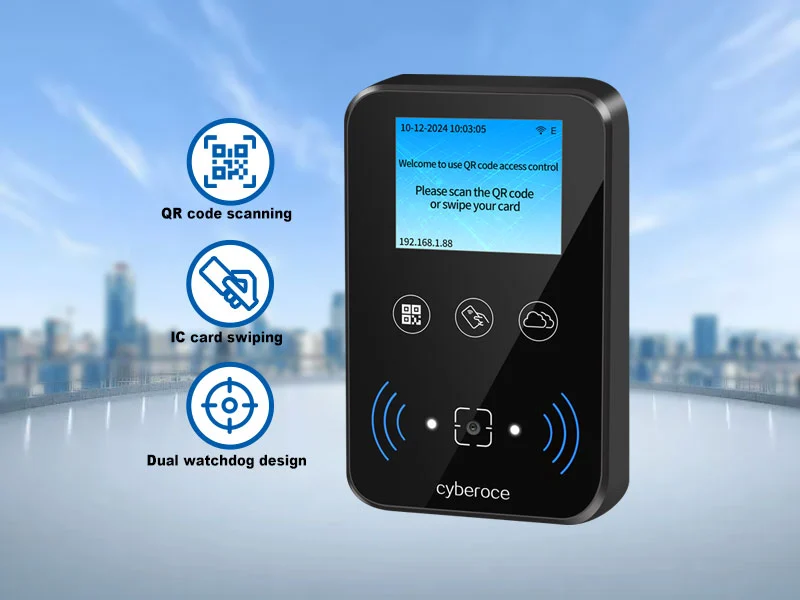
- The Scanning Module: continuously monitors the camera status and image decoding process, maintaining stable reading even under changing lighting conditions or frequent traffic, thus reducing traffic interruptions caused by recognition anomalies.
- Card Swiping Module: The chip communication process is under control, and the normality of command return can be judged in real time to avoid the situation of "swiping but no response".
- Network Module: The network status is continuously monitored, and even if there are fluctuations in the on-site network, the device can adjust the connection status in a timely manner to ensure uninterrupted data transmission.
These modules operate independently and do not interfere with one another. If an issue occurs in one module, the system prioritizes handling it locally, without affecting the overall operation. This approach keeps problems contained, preventing minor faults from escalating into system-wide issues.
In long-running projects, Cyberoce’s modular monitoring approach can significantly reduce the number of on-site failures and allow equipment to maintain a more stable operating experience in high-frequency usage scenarios.
II.Simultaneous software and hardware involvement ensures more stable operation of access control with QR Code
Software by itself can’t handle all the challenges in real-world environments. On many sites, network drops and unstable power are common, and devices can stop responding if there’s no hardware monitoring.
Cyberoce QR code access control systems add independent hardware monitoring alongside software self-checks. This allows the device to detect problems in real time and take action automatically, instead of staying stuck in an abnormal state.
III.Dual watchdog design – preventing equipment from getting stuck for extended periods.
To handle extreme situations, Cyberoce QR code access control devices employ a dual watchdog design:
- Built-in watchdog: The main chip monitors whether the software is running normally.
- External reset chip: Independently monitors the overall system status and triggers a reset upon detecting an anomaly.
This approach is not intended to increase complexity, but rather to prevent equipment from remaining unrecoverable for extended periods in abnormal conditions, thus affecting normal on-site operation.
IV.Long-term usability has always been a pursuit of Cyberoce.
Access control systems are devices used every day. Through core module self-testing, automatic anomaly recovery, and necessary hardware protection, the system can remain stable during long-term operation, reducing manual intervention. For property management companies and businesses, smooth access and minimal maintenance are the most direct and tangible results.
Stability is not just a slogan; it means that the equipment works normally every day.

No comments:
Post a Comment